Once upon a time, digital printing was the golden child. Quick turnarounds, low-volume flexibility, and on-demand customisation made it seem like the obvious future of print.
For years, the print industry was abuzz with the belief that digital would eventually take over — pushing traditional lithographic (offset) printing into the background.
But what if we told you the script has flipped?
While everyone was looking to digital for speed and simplicity, litho was quietly undergoing a transformation. Today, thanks to major leaps in automation and press technology, litho is not only holding its ground — it’s outpacing digital in areas we once thought impossible.
The Digital Promise: A Revolution in Speed
Digital printing changed the game. No plates, no setup times, no large-volume commitments. For short runs, personalisation, and rapid turnarounds, it was unbeatable.
It offered:
-
- Fast, on-demand printing
-
- Affordable short runs
-
- Variable data (like names or unique codes)
-
- Low waste and high agility
For marketers, publishers, and small businesses, this was a win. Print only what you need, when you need it.
The prediction? Digital would only get faster and cheaper — and eventually replace litho entirely.
But Litho Wasn’t Standing Still
While digital captured attention, lithographic manufacturers were investing in innovation — and the results are now impossible to ignore.
Heidelberg Leads the Charge
Heidelberg, one of the most trusted names in offset printing, has been quietly working to remove the barriers that once made litho slower and more expensive.
At drupa 2024, they unveiled a game-changing advancement: the Prinect Touch Free workflow. According to Heidelberg:
“With hybrid production and autonomous printing, the Prinect Touch Free workflow handles orders independently, eliminating manual intervention from incoming order to the finished product.”
— Heidelberg Media Week, 2024
They’ve also upgraded their flagship Speedmaster XL 106, showcasing how far litho has come. With the introduction of Intellistart 3, Heidelberg claims a:
“70% reduction in operating steps per job change.”
— Heidelberg drupa 2024
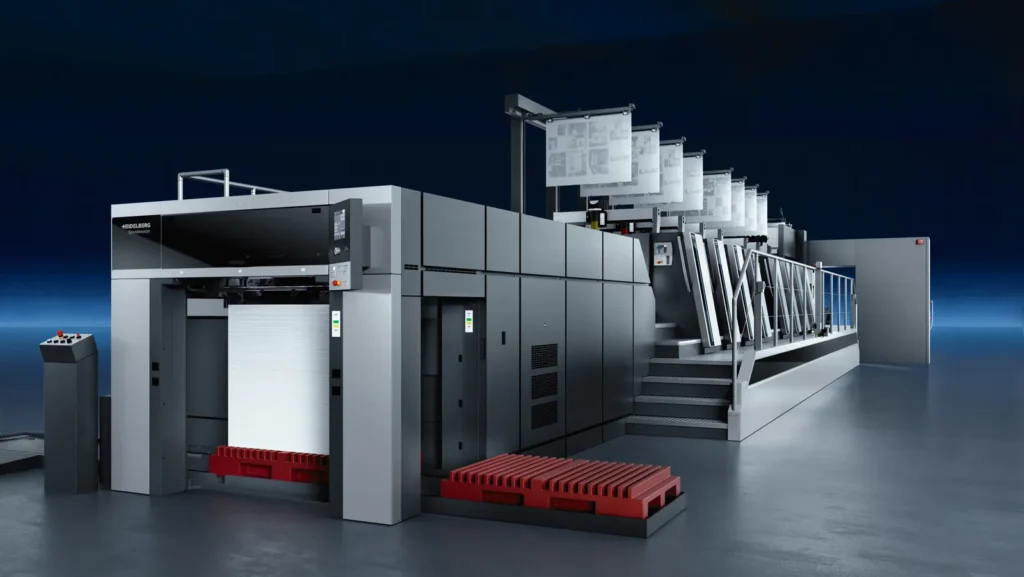
Even more impressively, Heidelberg’s Color Assistant Pro has slashed make-ready time by up to 4 minutes per job, while reducing waste sheets by 100–150 per setup.
In a production environment, that’s not just an upgrade — it’s a game-changer.
So Where Does That Leave Digital?
Let’s break it down.
| Factor | Digital Printing | Litho Printing |
|---|---|---|
| Short runs (<250 pcs) | ✅ Ideal | ❌ Less efficient |
| Medium runs (500–2,000 pcs) | ⚖️ Competitive | ✅ Often cheaper |
| Large runs (3,000+ pcs) | ❌ Expensive per unit | ✅ Cost-effective |
| Colour control | ✅ Strong | ✅ Exceptional |
| Setup time | ✅ Instant | ⚠️ Now lightning-fast |
| Waste | ✅ Low | ✅ Improving with automation |
| Variable data | ✅ Personalisation-ready | ❌ Limited |
| Cost per unit | ❌ Higher on volume | ✅ Lower on volume |
What We’re Seeing at Brandset
At Brandset, we’re constantly balancing speed, quality, and cost across client jobs — and the numbers don’t lie.
When it comes to high-volume marketing pieces — think 100,000 flyers or thousands of brochures — litho often beats digital not just on cost, but on turnaround too. We’ve watched clients make the switch and save significantly, with better quality control to boot.
Of course, digital still shines in smaller, nimble jobs — especially when personalisation or fast iterations are required. It’s not about picking sides. It’s about knowing which tool is right for the job.
The Bottom Line: Litho Didn’t Die. It Evolved.
The industry may have bet on digital — but litho had other plans.
With innovations from global leaders like Heidelberg driving automation and cutting waste and downtime, litho is faster, smarter, and more competitive than ever.
It’s not a question of old vs. new. It’s a question of strategy.
Need Help Choosing Between Digital or Litho?
At Brandset, we guide you through the options. We’ll help you weigh speed vs. scale, cost vs. customisation — and quote the right solution for your specific project.
📨 Let’s talk print — because one size doesn’t fit all, and we don’t believe in cookie-cutter advice.